 By
By Seven weeks after the Hindustan Group of Institutions presented her with an award, one of its schools gave her the microphone, the stage and the prize table.
Chennai: A prize-giving ceremony is one of the oldest rituals in school life, and its format hardly ever changes. A child walks up. An adult, usually a distinguished guest, hands over the trophy, shakes the child’s hand, and says a few encouraging words. The adult is the authority. The child is the recipient. Everyone knows the role they have to play.
At Buckingham Hall in Karapakkam on Saturday, 8 August, the person presenting the trophies was nine years old.
Victoria Isaac, who performs as Victoriastic, was the chief guest at the closing ceremony of Esperanza 2026, the inter-school cultural and sports festival hosted by Hindustan International School. The day opened at nine in the morning with the Tamizh Thaai Vaazhthu and the school anthem, and continued through a full schedule of cultural and sporting events involving teams from several schools across the city. By the time the valedictory session began, the winners had already been decided. What remained was the address, the performance and the prize distribution, and all three belonged to the chief guest.
Seven weeks earlier
The booking has a short history worth setting out, because it is unusual.
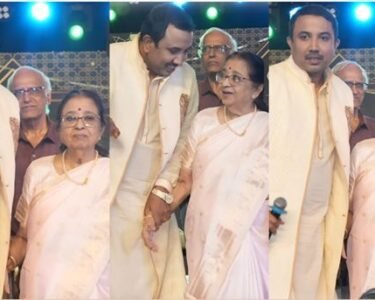
On 23 June, at Hotel Hilton in Chennai, the Hindustan Group of Institutions held the Dr. K.C.G. Verghese Excellence Awards 2026 as part of its sixtieth-anniversary year. Among the honorees, alongside industrialists, academics and a judge of the Madras High Court, was Victoria Isaac, who was named Child Prodigy of the Year.
Seven weeks later, the same group invited her back, not to receive recognition, but to lead the closing ceremony of its school’s biggest event of the year.
That is a different kind of endorsement from receiving an award. An institution can give a citation to almost anyone based on the strength of a file. Putting the same person in front of several hundred students and their teachers, and trusting her with the final hour of a day the school has spent months preparing, requires having watched her work and concluded that she can carry a room.
The Chairman’s vision for the school
Dr. Anand Jacob Verghese is Chairman of the Hindustan Group of Institutions and Chancellor of Hindustan Institute of Technology and Science. Under his leadership, the group secured university status for its engineering college, developed academic partnerships with institutions abroad, and now educates more than twenty-three thousand students across engineering, aviation, management, law, health sciences and the liberal arts. Its guiding line, reflected in everything it does, is to make every man a success and no man a failure.
Speaking at the group’s Excellence Awards in June, he described education as one of the most powerful instruments of transformation and nation-building, and described six decades of the group’s work as a record of nurturing talent and creating room for young people to discover what they are capable of. His own professional background spans close to three decades across education and aviation.
Esperanza shows what that idea looks like when it is applied to schoolchildren instead of appearing in a university prospectus. A school that measures its students only by examination results has a narrow definition of success and leaves a large number of children outside it. An inter-school festival expands the field. It creates categories where a child who is not first in class can still be first at something, and it allows them to achieve that in front of visiting schools rather than only their own. It costs the host school money, staff time and an entire Saturday, which is the point: that commitment is what makes it more than a sentiment.
The choice of chief guest follows the same logic. Victoria’s record is not academic. It is built almost entirely from things she taught herself to do, which is precisely the kind of achievement a school shaped by that motto should be placing before its students.
The people who actually run it
Hosting an inter-school event is a logistics exercise presented as a celebration. Visiting teams have to be welcomed, registered, fed and kept to a timetable.
Judges need to be briefed and results collated quickly enough for the prizes to be ready when the valedictory session begins. Parents arrive. Nothing can be allowed to overrun.
That work fell to Principal Ms. Bharathi Lakshmi and her staff, supported by the school’s leadership, including Executive Director Lt. Gen. Bobby Mathews (Retd.) and Dean of Academics Mr. Johnson Mathew, with Dr. Annie Jacob, Director of KCG College of Technology, among those present.
The measure of that work is that visiting schools noticed the organisation rather than the gaps. Very little of that effort is visible in a photograph, and all of it is the reason the day worked.
The last hour
Victoria’s slot was divided into three parts: an address, a violin performance, and the prize distribution.
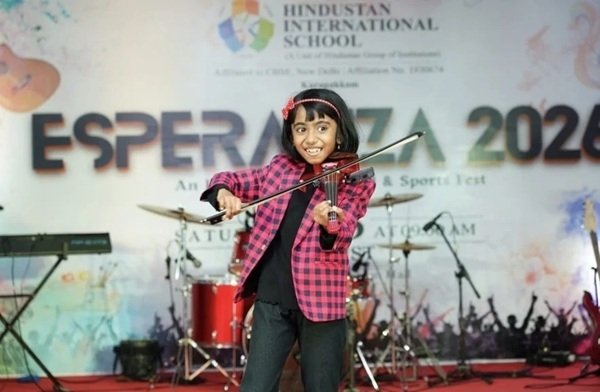
She spoke first, briefly, to a hall full of students. Then she played the violin, which was what the room had been waiting for since her name appeared on the invitation. The reaction was what it usually is when she performs for an audience of children: a hall that had been managing its attention for several hours suddenly stopped managing it.
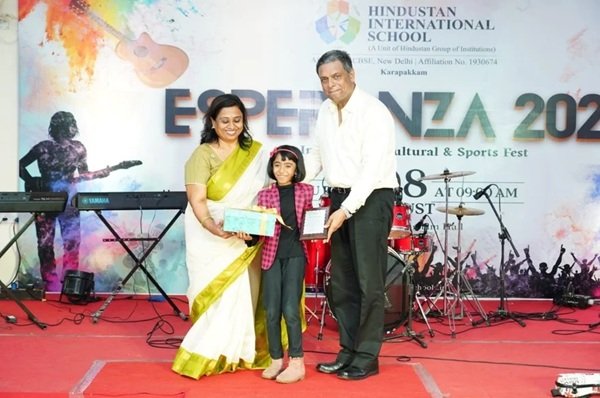
Then she presented the prizes.
That final part is worth pausing over because it does something a school cannot buy. A trophy presented to a child by a dignitary confirms the established order: adults decide, children receive. A trophy presented by someone of the same age says something else entirely. It says the person who has achieved remarkable things is not from a separate category of human being. She is from your category. She is standing where you are standing, holding out your medal.
Every winner at Esperanza 2026 returned to their seat having shaken hands with what is possible before eighteen.
What another school would be booking
For schools considering a chief guest for their own annual day or festival, the Esperanza booking is useful on two counts.
The first is that the Hindustan Group did not take a chance on an unknown. They had already assessed her, honoured her in June, and then chose to place her before their students in August. Repeat business from a serious institution is a stronger reference than any citation.
The second is what she is actually asked to do. Most chief guests deliver a speech and leave. Victoria delivers a speech, a performance and a prize distribution, and the performance is the part students are likely to describe at home that evening. A school gets an address, a concert and a ceremony from a single invitation.
She is nine, home-schooled, a student of the KM Music Conservatory in Chennai, and has spent the past year moving between award stages, care homes, corporate halls and now school festivals. The school festivals seem to be the ones she enjoys most. The audience is closest to her own age, and it is the only audience that reliably asks her questions afterwards.